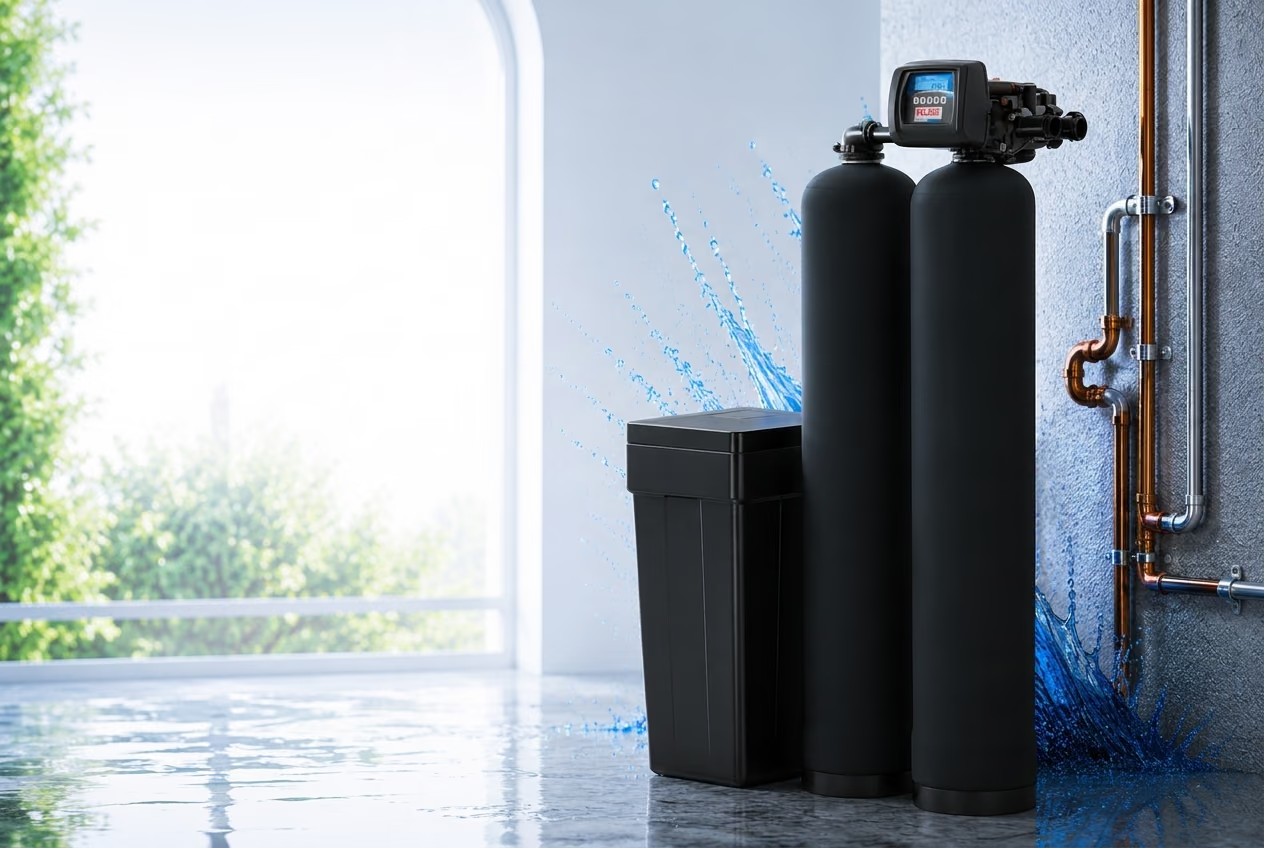
There is a white crust on the faucets that comes back a week after you scrape it off. The dishes and glasses come out of the dishwasher spotted and cloudy. The shower door never looks clean, your skin is dry and itchy all winter, and the water heater you replaced eight years ago is already rumbling. That is hard water (calcium and magnesium dissolved out of limestone), and in eastern Iowa nearly every tap has it. A properly sized water softener is the fix, and it is the core product Midwest Water Solutions sells, installs and services, from our shop just east of DeWitt across Clinton, Jackson and Scott counties and the Illinois side of the Quad Cities.
How hard is the water here? River towns vs. well towns
The part most people do not know: hardly anyone around here gets softened water from the utility.
Davenport and Bettendorf drink Mississippi River water from Iowa American Water. The plant coagulates it, filters it through granular carbon, disinfects with chloramine, and does not soften it. The utility's own water-quality sheet lists hardness at 136-350 mg/L, which is 7.9-20.4 grains per gallon depending on river flow, with a typical year around 235 mg/L, or about 13.7 gpg. "City water" in the Quad Cities is hard to very hard, and it swings enough across the seasons that an old softener set once and forgotten is wrong for part of the year.
Clinton is on Iowa American's deep Jordan wells, roughly 2,200 feet down, and the last published hardness figure was 260 mg/L (15.2 gpg). DeWitt's own city wells run about 13 gpg by Iowa DNR raw-water sampling, with sodium already at 110-120 ppm before any softener touches it. Fulton, Illinois, filters iron at its plant but leaves the hardness alone at 307 mg/L, about 18 gpg. Eldridge and Rock Island publish no hardness number at all: Eldridge's wells sit in Silurian dolomite whose regional median runs 15-16 gpg, and Rock Island's river plant, like Davenport's, does not soften. Somewhere around 10 grains is a fair guess, but a free in-home water test is the only way to get your actual number.
Every private well outside those systems is drilled into Silurian dolomite or the deeper Jordan sandstone, and dolomite is, chemically, calcium-magnesium carbonate. Grand Mound's municipal well, in the same rock the acreages around DeWitt pull from, computes to about 18 gpg with 1.7 mg/L of iron on top of it.
Maquoketa is different. The city has run an ion-exchange softening plant since 2006 but publishes no finished hardness figure, so plenty of in-town homes still run a softener of their own, and the free in-home test is how you find out how much work yours would have to do. Many Maquoketa households pair it with reverse osmosis at the kitchen tap for the sodium in the finished water (68-73 ppm) and the radium questions that come with deep Jordan wells, plus salt and service on the units already in their basements.
How a water softener works
Worth knowing
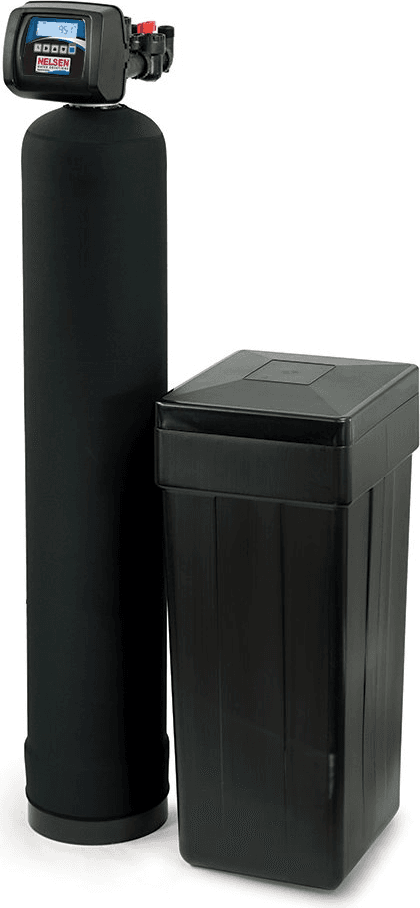
A softener is a tall mineral tank full of resin beads, a squat brine tank full of salt, and a control valve on top that runs the show.
The resin bed does the work. Each bead carries sodium ions on its surface. As hard water flows down through the bed, calcium and magnesium (which the resin holds onto more tightly) swap places with the sodium. What leaves the tank is soft water. That is ion exchange, and it is the only residential technology that actually removes hardness rather than managing it.
Eventually the beads are loaded with calcium and magnesium and have no sodium left to trade. The control valve then runs a regeneration cycle: it backwashes the bed to loosen it, draws concentrated brine up from the brine tank through the resin so the flood of sodium pushes the hardness ions off the beads and down the drain, rinses, and refills the brine tank for next time. The cycle takes roughly 90 minutes to two hours and is usually set for 2 a.m. when nobody is running water. Regeneration is why the unit needs a floor drain, and why it lives in the basement or utility room next to the water heater in nearly every eastern Iowa house.
Two things to know before you buy. First, metered (demand-initiated) valves count gallons and regenerate only when the resin is actually spent; old timer valves regenerate on a clock whether you used water or not, and burn salt and water for nothing. Every unit we install is metered. Second, every softener has a bypass valve on the head (a lever or a pair of knobs) that sends water around the unit. If a softener ever floods or will not stop running, that is the thing to turn first.
Sizing: grains per gallon and household use
Softener capacity is rated in grains: 32,000, 48,000, 64,000. The math is straightforward. Take your hardness in grains per gallon, multiply by the number of people in the house, multiply by about 75 gallons per person per day, and that is the hardness the unit removes daily. Multiply by the days you want between regenerations (about a week is the efficient target) and you have the capacity you need.
A family of four on Clinton water at 15 gpg: 15 x 4 x 75 = 4,500 grains a day, 31,500 a week, a 32,000-grain unit at a sensible salt dose. The same family on a rural well at 18 gpg with 1.7 ppm of iron is a different job. Every ppm of dissolved iron adds roughly 3-5 gpg of equivalent load, so the compensated hardness is closer to 25 gpg: 7,500 grains a day, and a 64,000-grain unit. Undersize it and it regenerates every other night, eats salt and fouls the resin; oversize it and you have paid for a tank that sits half-used. Flow rate matters as much as capacity: a two-story with three baths and a tankless heater needs a valve and tank diameter that will not choke pressure when two showers and the washer run at once. We size from your numbers, not from a catalog.
Salt-based softener vs. salt-free conditioner
A salt-free "conditioner" (template-assisted crystallization) does not remove calcium and magnesium. It changes their crystal form so scale is less likely to stick to pipes and heating elements. It does nothing for the spots on the glass, the soap that will not lather or the dry itchy skin, and it cannot handle iron. On very hard eastern-Iowa well water, a Silurian well at Grand Mound tested about 18 gpg, and Fulton's city water runs about the same, the difference is night and day. Where salt-free earns its place is a low-hardness supply where someone wants only scale protection on a tankless heater; that is not eastern Iowa. If you are not sure what you have, our guide to telling if you have hard water walks through the signs, and the free test settles it.
Buying, renting and servicing: all brands
We sell and install new metered softeners sized for your house, and we repair and service every brand already sitting in eastern Iowa basements: Culligan, Kinetico, EcoWater, Whirlpool, GE, Morton, and the many units built on Fleck or Clack valves. A salt bridge in the brine tank, a fouled resin bed, a leaking valve seal or a unit that keeps running is usually a repair, not a replacement, and we tell you which. Details on what a new unit includes and typical cost ranges live on our new water softener purchase and install page; symptoms and fixes for an existing unit are on repair and service for all brands. A softener that is flooding the basement or stuck in regeneration is the one genuine emergency in this trade: we run a 24/7 phone line and get on-site within 2 hours for those calls. Turn the bypass valve first, then call (563) 221-9009.
Rent or buy? The honest answer: renting makes sense if you are in a house for a year or two and do not want to own equipment. Beyond that, monthly rental fees typically add up past the price of owning a unit outright, a rental cannot be upgraded or moved when you do, and you are still the one hauling the salt. Rental swaps at the end of a lease are a common job around the Quad Cities. Whichever way you go, salt delivery keeps the brine tank stocked so the resin never sits unregenerated.
Softeners on well water: iron first
If your well runs iron (orange stains in the toilet and tub, a rusty smell, water that turns brown after it sits), a softener on its own will foul, because the resin bed catches iron it cannot fully release during regeneration. Above about 1 ppm, an air-injection iron filter goes ahead of the softener so the resin only ever sees hardness; that is the standard package on Silurian wells around DeWitt, Grand Mound, Welton and rural Scott and Jackson counties. Two more things matter on a well: the regeneration discharge needs a floor drain, and on septic the brine should be kept out of the drainfield where the county allows. Iowa's time-of-transfer inspection at every rural sale looks at exactly that, and Illinois private-sewage rules generally want softener backwash routed to a separate seepage system. Clinton, Scott and Jackson county health departments all offer free bacteria and nitrate testing on private wells; we will point you to the right one while we run the hardness and iron numbers in your kitchen.
Where we install
If you have been searching "water softener Quad Cities" and getting nothing but rental offers, or "water softener near me" from a DeWitt kitchen with a crusted faucet, the answer is the same: an honest sizing, a free in-home test if you want one, and a unit you own. From our shop east of DeWitt we install and service softeners in DeWitt, Davenport, Bettendorf, Clinton, Eldridge, Maquoketa, Rock Island and Fulton, plus the farms and acreages between them. Residential and small commercial (restaurants, offices, shop buildings) get the same approach. Scheduled tests and installs run Monday through Friday, 8am to 5pm.
If you are tired of scraping crust off the faucets, get a free estimate or call (563) 221-9009. The estimate is free, the water test is free if you want one, and both come with a straight answer.