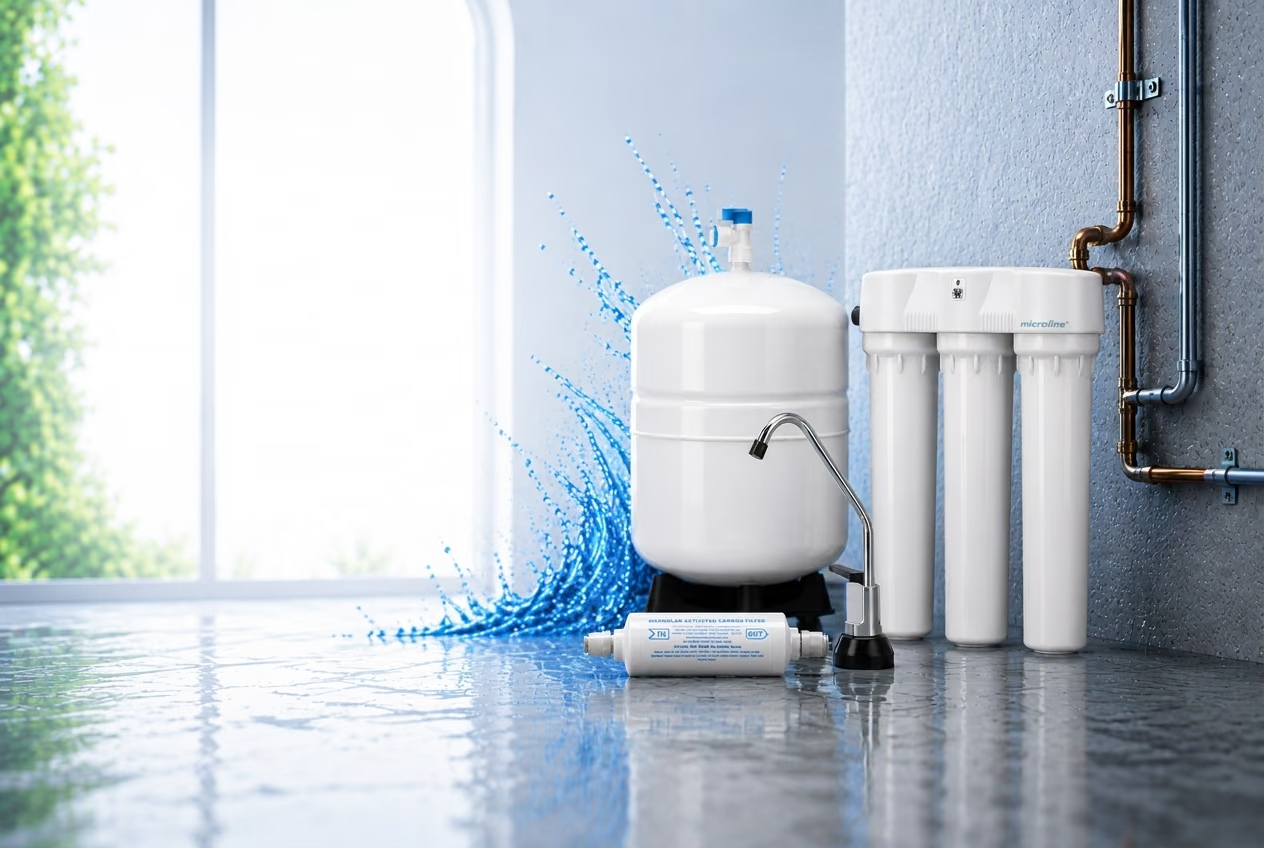
There is a case of bottled water on the floor by the fridge, and another one in the garage. Nobody in the house drinks from the tap anymore because the tap water tastes bad (flat, a little chemical, sometimes faintly metallic), and the ice is cloudy no matter how many times you clean the ice maker. "We only drink bottled water" is one of the most common sentences we hear on a free water test in DeWitt and the Quad Cities, and it usually ends the same way: an under-sink reverse osmosis system, a dedicated drinking-water faucet, and a family that stops hauling plastic.
That is the taste half of the story. The other half is the one you can't taste at all, and in eastern Iowa farm country it is the better reason to put a reverse osmosis system on the water you drink.
What reverse osmosis removes (and why nitrates matter here)
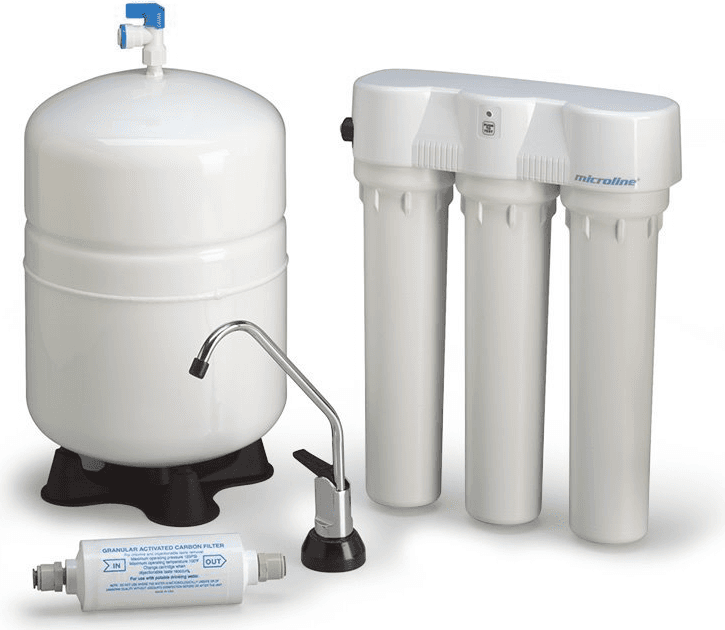
A reverse osmosis membrane is a sheet of thin-film composite rolled tight in a housing. Water is pushed through it under your line pressure, and the membrane passes water molecules while rejecting dissolved solids, roughly 90 to 99 percent of the total dissolved solids (TDS), depending on the contaminant and the water temperature. That is a fundamentally different job from a carbon filter, which traps chlorine and organic taste, or a softener, which swaps hardness for sodium. RO takes out what is dissolved in the water: nitrates, lead, arsenic, radium, sodium, sulfate, fluoride, and most of the PFAS family.
Nitrates are the eastern-Iowa reason. The federal limit is 10 mg/L as nitrogen. A 2019 review of Iowa's private-well records found more than 6,600 wells averaging at or above that limit between 2002 and 2017 (about 12 percent of wells tested), and the shallow, poorly cased wells in row-crop country are the ones that hit it. Princeton's shallow 2020 municipal well in Scott County has run 12 to 16 mg/L. Even the river water Iowa American Water serves in Davenport and Bettendorf posted a single-sample high of 4.43 mg/L in 2025, with the utility's own report warning that levels can rise quickly for short periods after rain and planting. Nitrate has no taste and no smell. You cannot boil it out; boiling concentrates it. Reverse osmosis is one of the few point-of-use treatments that reliably removes it, which is why it is the standard answer for infants, pregnant women and anyone on a farm well. We wrote up the full picture in our nitrates in well water guide.
The list keeps going once you look at the local reports. DeWitt's deep Jordan wells read 3.1 pCi/L combined radium at two of three wells, and one of Maquoketa's sat right at the 5 pCi/L limit in late 2025. Clinton's district picked up short-chain PFAS in 2025 sampling. Rock Island's most recent lead round put four homes over the 15 ppb action level. Every one of those is a dissolved contaminant an RO membrane handles at the kitchen tap. On PFAS we will be straight with you: RO does its best work on the long-chain compounds; short-chain ones like PFBA are harder for every treatment, including this one.
How an under-sink RO system works (stages, tank, faucet)
A standard under sink reverse osmosis system is four stages in series, and the order matters.
- Sediment prefilter. A 5-micron cartridge that catches sand, rust and silt so they never reach the membrane. On a well this is the stage that plugs first.
- Carbon block. Chlorine and chloramine destroy a thin-film membrane, so a carbon block sits in front of it. Iowa American Water's Quad Cities supply runs a chloramine residual around 3 ppm, and chloramine needs more carbon contact time than free chlorine, so we size this stage (or use catalytic carbon) for what is actually in your water.
- RO membrane. The workhorse. Residential membranes are rated at 50 to 100 gallons per day at 60 psi and 77 degrees; in a real basement on real winter water you get less, which is fine because the tank does the buffering.
- Post-carbon polisher. A small inline carbon filter after the tank that removes any taste the water picked up sitting in the bladder.
Two more pieces make it a drinking-water system rather than a science project. The RO storage tank (a steel or composite tank with a rubber bladder, nominally 3 to 4 gallons and holding 2 to 3 gallons of actual water) fills slowly over a few hours and delivers a strong stream when you open the faucet. The drinking-water faucet is a dedicated lead-free tap mounted through the sink deck or countertop, separate from the kitchen faucet. From the tank we can also run a quarter-inch line to the refrigerator so the ice maker and door dispenser get RO water; cloudy ice clears up in the first batch after the old ice is dumped.
Two honest notes about how the technology behaves. First, every RO membrane sends reject water down the drain: the dissolved solids have to go somewhere. Standard systems run around 3 to 4 gallons to drain per gallon produced; a permeate pump or a newer high-efficiency unit brings that close to 1 to 1, and on a well with a septic system that is worth specifying. Second, RO needs pressure. Above 40 psi it works as rated; a well system whose pressure switch is set 30/50 may want a permeate pump or booster, and we check that before quoting.
Worth knowing
Filter changes are a separate subject: the prefilters and post-carbon yearly, the membrane every few years, and the whole system sanitized when cartridges are swapped. Our RO and filter service page covers that, for systems we installed and for the Culligan, Kinetico, Whirlpool and every other brand already under sinks across the area.
Whole-home reverse osmosis: RO in the basement for every tap
Not every household wants purified water at one faucet only. For homes that want it at every fixture, we install whole-home reverse osmosis in the basement or utility room, at the point of entry, with its own storage so purified water reaches the whole house rather than a single tap. It is the system people ask for when a second kitchen, a wet bar and a hard-working ice maker all need purified water, when they simply want it at every tap, or when an acreage owner wants a spot-free rinse for the vehicles. The stages are the same as the under-sink system, scaled up, and the softener-ahead-of-the-membrane rule below matters even more at this size. Whether a whole-home system or an under-sink unit fits your house comes out of the free estimate, with a free water test first if you want the numbers.
RO and your softener: the standard pairing
Ask why hard-well households around DeWitt almost always end up with both a softener and an RO, and the answer is membrane life. A thin-film membrane fouls with calcium scale the same way a water heater does. Manufacturers generally want feed hardness under about 10 grains per gallon; DeWitt's municipal supply runs roughly 13 gpg, and private Silurian wells out on the acreages commonly test 18 gpg or more. Feed a membrane that water unsoftened and you replace it every year instead of every three to five. Put a water softener ahead of it and the membrane sees soft water, lasts, and holds its rejection rate.
The pairing pays back the other direction too. A softener trades each grain of hardness for roughly 8 milligrams of sodium per liter. On 13-grain water that is around 100 mg/L of added sodium on top of what is already there (and DeWitt's wells already carry 110 to 120 ppm naturally, Maquoketa's softened city water 68 to 73 ppm). Anyone on a sodium-restricted diet notices. The RO membrane takes that sodium back out at the one tap you drink from, which is exactly why the two systems are sold together rather than as competitors.
What an RO system costs installed
If you have been searching reverse osmosis cost, here is the honest framing. National cost guides put a professionally installed under-sink RO system in roughly the $400 to $1,500 range. What moves a specific job inside that range: a remineralization stage after the membrane if you want the mineral taste back, a permeate pump for low well pressure or drain efficiency, a higher-output membrane for a big household, and the refrigerator line. Ongoing cost is cartridges, usually changed once a year. A whole-home system is a larger piece of equipment with more plumbing, so it is quoted on the free estimate rather than from a national range.
The free estimate covers the system you ask for, fitted to your cabinet, drain trap and sink deck. If you would rather see what is in the water first, the in-home test is free too. Small commercial customers (a restaurant that wants clear ice and better coffee, an office with a water cooler, a shop building on a well) get the same treatment, usually with a higher-output unit and a larger tank.
Installation day
Installs are scheduled Monday through Friday, 8am to 5pm, and most residential jobs are finished in a single visit. Here is what happens under your sink:
- Faucet. We use the sprayer or soap-dispenser hole if the sink has a spare one; if not we drill a clean hole through the stainless or the countertop and set the drinking-water faucet with its base gasket.
- Feed and drain. A proper feed adapter valve on the cold supply, never a self-piercing saddle valve, which is the number-one source of under-sink leaks. The drain connection goes through an air gap so nothing from the trap can siphon back toward the membrane.
- Housings and tank. The filter manifold mounts on the cabinet wall where cartridges are easy to reach; the tank is pre-charged to 5 to 7 psi and set where it will not block the garbage disposal.
- Fridge line. Quarter-inch tubing to the refrigerator, secured so it cannot kink, with a shutoff at the tee.
- Flush and check. The first tank fill is dumped to clear carbon fines and the membrane's preservative. We pressure-check every fitting, measure the TDS at the new faucet against the tap, and show you the difference.
Where we install
Our shop is just east of DeWitt, and reverse osmosis, under the kitchen sink or as a whole-home system in the basement, is the drinking-water answer we install across Clinton, Scott and Jackson counties and the Illinois side of the Quad Cities. In DeWitt and out on the acreages around it, RO rides behind a softener on hard well water and handles the spring nitrate. In Davenport and Bettendorf on Iowa American Water's river supply, it is chloramine taste, seasonal nitrate and atrazine at the tap. In Rock Island the lead-line inventory makes an under-sink RO a sensible hedge. In Clinton it is radium, sodium and the PFAS results. In Maquoketa, RO for radium, sodium and lead is the common in-town add-on.
Whichever water you are on, you can go straight to a quote for the RO you want, or ask for a free in-home water test and see the numbers first. If a test says your only problem is chlorine or chloramine at every tap, we will tell you a carbon filter is the better buy. If it says dissolved solids, nitrates or anything on the list above, the fix is a reverse osmosis system at the sink. Call (563) 221-9009 or request a free estimate, and stop carrying cases of water into the house.