A whole house carbon filter is what takes the chlorine smell and taste out of every tap in the house, not just one. The shower is where you notice it first. Hot water hits the tile and the bathroom smells like the deep end of a public pool. Then the coffee tastes off: flat, a little bitter, not what the same beans made at your sister's house on a well. A glass straight from the kitchen tap tastes like chemicals if you let it sit. Your skin feels tight after a shower and your hair never quite gets soft. If any of that sounds like your house, the water smells like a pool because it is treated with the same thing a pool is: chlorine, or its longer-lasting cousin chloramine. A whole house carbon filter takes it back out at the point of entry, before it reaches the water heater, the coffee maker or the shower head.
Midwest Water Solutions installs and services whole-house carbon systems on city water across Clinton, Jackson and Scott counties and the Illinois Quad Cities, and we offer a free in-home water test to anyone who wants one. Knowing your disinfectant matters more on carbon than on almost any other system, because the river towns and the well towns around here are disinfected two different ways, and the wrong carbon simply stops working.
Why city water tastes like chlorine (and what chloramine changes)
Every public water system is required to leave a disinfectant residual in the pipes so the water stays safe between the plant and your tap. Iowa American Water's Quad Cities system (Davenport, Bettendorf, LeClaire, Riverdale) draws from the Mississippi, filters it through granular activated carbon at the plant, disinfects with UV, and then adds chloramine so the residual survives the trip through miles of mains. The 2025 report shows a running average of 3.0 ppm with single readings up to 3.81. Rock Island's own river plant does much the same, adding chloramine at 2 to 3 ppm after UV.
Chloramine is chlorine bonded to ammonia. It is more stable than free chlorine, which is exactly why utilities on long distribution systems like it, and exactly why it is harder to get out of your water. Standard granular activated carbon relies on chlorine reacting with the carbon surface, and chloramine does that reaction slowly. A GAC cartridge that would last a year on free chlorine can be exhausted in weeks on 3 ppm chloramine. The utility's own report notes that chloramine removal differs from chlorine removal, and anyone who has bought a carbon filter at a hardware store in Davenport and watched the pool smell come back by Thanksgiving has learned that firsthand.
River water also brings disinfection byproducts. When chlorine or chloramine meets the organic matter in Mississippi water, it forms trihalomethanes and haloacetic acids. The Quad Cities system reported running averages of 39 ppb TTHM and 37 ppb HAA5 in 2025, under the 80 and 60 ppb limits; Rock Island logged a single TTHM sample at 91 ppb that year, with the running average still under the limit. Carbon adsorbs these compounds well, which is a second reason the tank pays for itself on river water.
The well towns are a different story. Iowa American's Clinton district pumps from 2,200-foot Jordan wells and uses free chlorine at about 1.4 ppm. Fulton runs 0.9 ppm free chlorine, Maquoketa about 1 ppm. DeWitt and Eldridge chlorinate too, but their raw well water carries natural ammonia, so part of the residual may be combined chlorine without anyone intending it. That is why our free test includes a free-versus-total chlorine split at your tap: the gap between the two numbers is the chloramine, and it decides the media.
GAC vs catalytic carbon
Worth knowing
Standard GAC (coconut shell or bituminous coal, activated with steam so a single pound has acres of internal surface) is the right media for free chlorine, disinfection byproducts, organics and most taste-and-odor complaints on well-based city systems like Clinton, Fulton and Maquoketa. It is less expensive per cubic foot and it lasts.
Catalytic carbon is GAC whose surface has been modified during manufacturing so it actively catalyzes the breakdown of the chloramine bond instead of waiting for it to react. On chloraminated water it has several times the working capacity of standard carbon, which is the difference between a tank that runs years and one that runs a season. It costs more per cubic foot, and it still needs contact time: a chloramine tank gets sized larger than a chlorine tank for the same house so the water spends long enough in the bed. For Davenport, Bettendorf and Rock Island, catalytic carbon is what we spec. For DeWitt or Eldridge, the split test tells us which way to go.
Whole-house tank vs cartridge filters
There are two ways to put carbon on the main line. A cartridge housing, the blue canister you have seen next to a water heater, holds a carbon block or GAC cartridge that you replace every six to twelve months. It is cheap to install and fine for a small household on free chlorine, but the cartridge is small, the pressure drop climbs as it loads, and it gets forgotten.
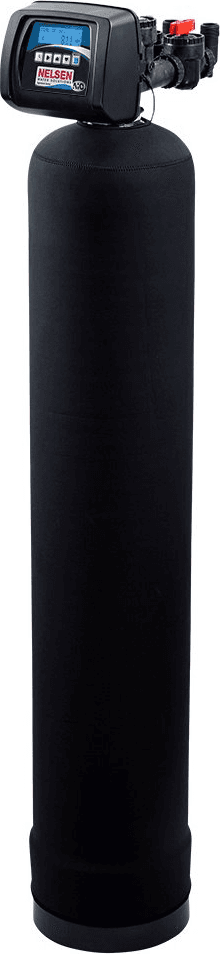
A backwashing carbon tank is a mineral tank the size of a softener, holding one to two cubic feet of media on a control valve. Every few days it reverses flow for a few minutes, lifts the bed, flushes trapped sediment to the drain and re-settles the carbon so water does not channel through the same path forever. There is nothing to change: no salt, no cartridges. On free chlorine, media life is typically three to five years; on chloramine with catalytic carbon, roughly the same. When the pool smell creeps back, we rebed the tank with fresh media rather than replacing the system. Where the mains send grit (Clinton and Davenport both flush mains every spring and the older iron mains shed rust), a spin-down or sediment prefilter ahead of the tank keeps the carbon doing its actual job.
Carbon + softener: the twin-tank setup
If you have a water softener on city water, the carbon tank belongs ahead of it, and here is why. Softener resin beads are a plastic polymer, and chlorine slowly oxidizes the crosslinks that hold each bead together. Over years the beads soften, swell, break down into fines and lose exchange capacity. The softener keeps regenerating and burning salt but the water comes out hard anyway. Chlorine attack is one of the most common reasons softener resin has to be replaced on city water. A carbon tank first in line strips the disinfectant, and the resin behind it lasts the way the manufacturer intended.
The pair is usually installed as two tanks sharing one drain: carbon first, softener second, bypass on both. If you are buying a new softener on city water, this is the setup we will lay out at the estimate. If you already have one (any brand), we can add the carbon tank in front of it.
Carbon on well water (odor, organics)
On a private well, carbon is a specialist, not a cure-all. It is the right media for musty, earthy or fishy odors from organic matter, for tea-colored water from tannins on bottomland wells, and for stripping chlorine after a chlorination system or a shock treatment. It is the wrong media for iron, manganese and rotten-egg sulfur: iron coats and plugs the bed, and sulfide loads it up in weeks. Those wells need an iron filter or an ozone system instead, and the free test sorts out which. One more honest note for well owners: a carbon bed with no disinfectant in the water can grow bacteria, so on a well we backwash more often and pair the carbon with whatever disinfection the water needs.
Where we install
We are based just east of DeWitt and install whole-house carbon across the Quad Cities and the river towns: Davenport, Bettendorf and Rock Island on chloraminated river water, Clinton on chlorinated Jordan-well water, and DeWitt, Eldridge, Fulton and Maquoketa on their own chlorinated municipal wells. A point-of-entry carbon tank does not treat what you drink beyond taste and odor: for nitrate, radium, sodium or lead at the kitchen tap, the answer is a reverse osmosis system, and if you already have one, chloramine-rated prefilters are part of RO and filter service.
Installs are scheduled Monday through Friday, 8am to 5pm. If you already know you want a carbon tank, ask for the estimate. If you would rather see chlorine versus chloramine at your own tap first, the free in-home water test covers it, with no obligation. Call (563) 221-9009 or request a free estimate and we will get you on the calendar.