"Is my water safe?" It's the question that shows up the week after you close on an acreage outside DeWitt, the day you bring a newborn home, or the morning the well water comes out of the kitchen faucet with a brown tint after three days of rain. If you're on a private well in Clinton, Jackson or Scott County, or on the Illinois bottoms around Fulton, nobody is checking that water but you. There's no utility, no annual report, and the county has no idea your well changed unless you send a sample. Free water testing is where many of the jobs Midwest Water Solutions does begin, and for a fair number of households it's also where the job ends: the numbers say the water is fine, we tell you so, and you go back to your day. The test is optional, too. If you already know the system you want, skip it and go straight to a free estimate.
We run testing on two tracks, and the honest version of this page is explaining which track your problem belongs on. The free in-home test answers the questions you can see, taste and feel. A certified lab answers the ones you can't. Most water problems in eastern Iowa are aesthetic (staining, scale, taste), not emergencies. A test is how you find out which one you have.
What the free in-home test measures
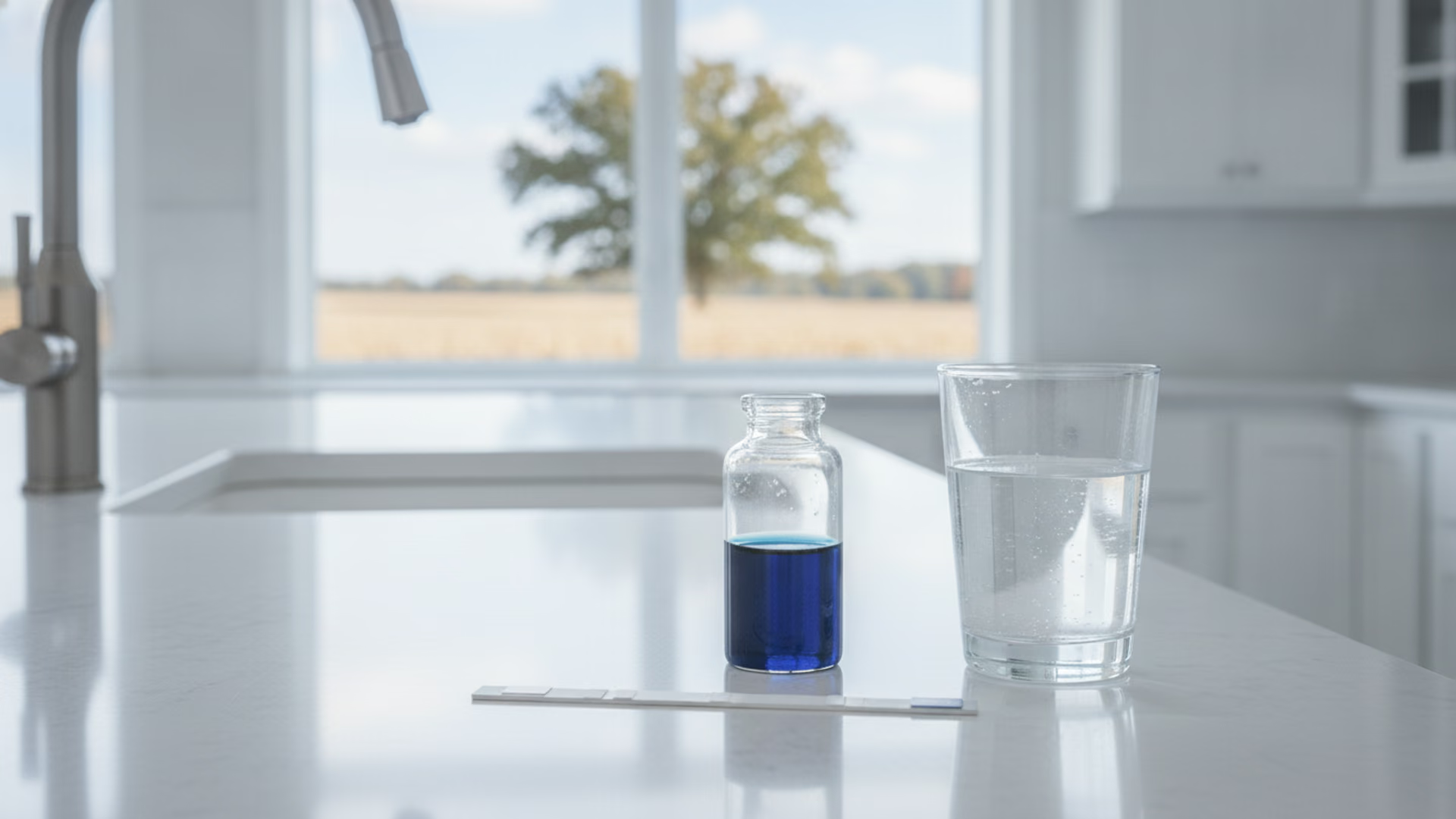
A standard dealer field kit measures what a treatment system can be sized against. At your kitchen counter, in about 30 to 45 minutes, we run:
- Hardness in grains per gallon (gpg) by titration: add reagent to a measured sample, count the drops until it turns from red to blue, and each drop is a grain. Strips get you to the neighborhood; titration gets you to the number a softener is programmed with.
- Iron and manganese with color-comparison vials, because these two are the reason for orange or rust stains in the toilet and tub and the black film inside a toilet tank.
- TDS (total dissolved solids) with a handheld meter. It's the fastest single read on whether an RO system is doing its job.
- pH, which tells us whether the water is corrosive to copper and galvanized plumbing.
- Free and total chlorine on city water, because the split between them decides whether standard carbon or catalytic carbon is the right media.
- A nitrate screen: a strip that tells us "low" or "worth a lab test," which matters in farm-country wells.
We pull three samples when the house has them: raw water from the outside spigot or ahead of the pressure tank, water from the kitchen faucet, and water from the RO drinking-water faucet if you have one. The difference between them is the point. Raw water at 22 gpg and kitchen water at 22 gpg means the softener in the basement is doing nothing, and we go look at the brine tank, the settings and the resin before anyone talks about a new one. Kitchen TDS of 480 and RO faucet TDS of 40 means the membrane is fine. Kitchen 480 and RO 300 means it isn't.
In-home test vs certified lab test: when each is right
The field kit is the right tool for hardness, iron, manganese, taste and odor, and for checking whether the equipment you already own is working. It's the wrong tool for anything with a health limit attached. If any of these apply, the sample goes to a certified lab:
- Bacteria. No field kit grows a coliform culture. "Well test came back positive" is a lab sentence, and it's the one that matters most.
- Nitrates in well water when someone is pregnant or an infant is on formula. The federal limit is 10 mg/L as nitrogen; a strip can't split 8 from 12, and a lab can. Our post on nitrates in well water covers where it comes from and who is at risk.
- Arsenic, radium and PFAS. Shallow bottomland wells around Fulton carry arsenic. The city's own raw well water runs 11 to 12 micrograms per liter before the plant removes it. Deep Jordan-aquifer wells in this region carry radium; two of DeWitt's three municipal wells sit at 3.1 pCi/L against a 5 pCi/L limit. Neither shows up in a kitchen kit.
- Real-estate transactions. Lenders and buyers want a certified result with a chain of custody, not a dealer's clipboard.
Search "well water testing near me" from anywhere in our territory and the answer on the Iowa side is your county health department, and it's free. Details below.
Reading your results: the numbers that matter
Numbers only help if you know where the lines are.
Hardness. Under 3.5 gpg is soft. Around 7 gpg is where spots on glasses and soap scum become a daily thing. Private Silurian wells around DeWitt and Grand Mound run about 18 gpg; the city's own Jordan wells test around 13; Fulton's finished water is about 18. At 25 gpg a water heater builds scale fast enough to shorten its life, and a softener stops being a comfort item. Sizing lives on our water softener page, and how to test water hardness yourself is covered in our hard-water guide.
Iron at 0.3 mg/L. That's the EPA secondary standard, and it's the point where staining starts. Grand Mound's well tests 1.7 mg/L (nearly six times that), which is why laundry comes out yellow on some acreages. Manganese stains black at 0.05 mg/L. Both are an iron filter job, not a softener job, once they get much past those lines.
Nitrate at 10 mg/L. The health limit. Deep wells here read near zero; shallow ones in the alluvium can blow past it: a shallow municipal well near Princeton has tested 12 to 16 mg/L. Over the line with a baby in the house means bottled water or an RO drinking-water system at the kitchen tap, and a lab confirmation.
TDS. Groundwater in this part of Iowa commonly reads 300 to 550 mg/L; the EPA's secondary guideline is 500. TDS isn't a safety number by itself: it's a taste number and an RO-performance number. If you only drink bottled water because the tap tastes flat or salty, TDS is usually the reason.
pH should sit between 6.5 and 8.5. Below that, water eats copper and leaves blue-green stains. Chlorine on city water is capped at 4 ppm; Davenport's chloramine runs about 3, which is why the coffee tastes off in some houses on the river system.
Two symptoms come up more than any other. Orange stains in the tub and a metallic taste almost always mean iron above 0.3 mg/L, and the fix is an oxidizing iron filter sized to the ppm. White crust on the faucets and a shower door that never comes clean means hardness above 7 gpg, and the fix is a properly sized softener (or a repair to the one you already have). A rotten-egg smell that's worse on the hot side is usually a water-heater anode reaction, not the well; the test tells us which before you buy anything for it.
Well water testing in Clinton, Jackson and Scott counties
Worth knowing
Iowa's Grants-to-Counties program means private-well testing on this side of the river is free, and the sanitarians who run it are good at their jobs. Use them.
- Clinton County Health Department, 226 11th St, DeWitt (563-659-8148): free total coliform, E. coli, nitrate, arsenic and manganese sampling; bacteria and nitrate yearly, arsenic and manganese every three years. Well permits are $150, and the county has grant money for shock chlorination, plugging and reconstruction.
- Scott County Health Department, 600 W 4th St, Davenport (563-326-8618): free annual coliform and nitrate sampling. They come out, pull the sample, send it to the State Hygienic Lab and mail the result. Cost-share for plugging and rehabbing old wells.
- Jackson County Environmental Health, 201 W Platt St, Maquoketa (563-652-1729): free E. coli, coliform and nitrate for new wells, after repairs or flooding, on any taste or odor change, and for households with newborns, pregnant or immunocompromised members; PFAS by application; $40 expedited sampling for a real-estate sale; results at the office the second Friday after collection.
Illinois has no free program. Whiteside County Health in Rock Falls charges $35 for bacteria, $36 for nitrate or $71 for both; Rock Island County charges $40 for coliform and $80 for coliform plus nitrate. Either way the sequence is the same: county lab for the health questions, our free field test for everything else, and one conversation that puts both sets of numbers on the table.
City water: what's already tested and what isn't
If you're on a municipal system, the health testing is done for you and printed in an annual Consumer Confidence Report. What the report doesn't tell you is what the water does to your house. Iowa American Water's Quad Cities system (Davenport, Bettendorf) pulls Mississippi River water, treats it with chloramine, and does not soften it: hardness runs roughly 8 to 20 gpg over the year, around 14 typical. Its Clinton district draws from deep Jordan wells at about 15 gpg with low-level radium and sodium. The City of DeWitt chlorinates its Jordan wells and doesn't soften: about 13 gpg, sodium of 110 to 120 ppm, TDS around 500 to 550. Fulton removes iron and manganese at the plant but leaves about 18 gpg of hardness. Eldridge doesn't publish a hardness figure at all. Maquoketa's city plant softens by ion exchange but prints no hardness figure either, so in-town Maquoketa questions run to radium, sodium and lead at the kitchen tap as well as how much a softener of your own would have left to do.
So on city water the free test is mostly about hardness at your tap, chlorine or chloramine taste, and whether your existing softener or RO is actually working. The utility tests the water leaving the plant; it doesn't test what your 1960s galvanized lines add on the way in.
What happens after the test: the no-pressure consultation
The consultation is a kitchen-table conversation with the numbers in front of you. It ends one of three ways. The first is that nothing needs doing: the water is fine, or the problem is cosmetic enough that you'd rather live with it, and we say so. The second is a fix you can do yourself: a salt bridge in the brine tank, an RO filter that's two years overdue, a water-heater anode that's making the hot side smell. We'll show you. The third is equipment (a softener sized to your gpg and household, an iron filter sized to the ppm, an RO at the kitchen tap), and that gets a written free estimate you can take anywhere. We sell, install and service all brands, so the recommendation is never tied to what's already in the basement.
Midwest Water Solutions is insured and based just east of DeWitt. Tests are scheduled Monday through Friday, 8am to 5pm, for homes and small commercial buildings across Clinton, Jackson and Scott counties and the Illinois side of the Quad Cities. If you've been wondering whether the water is safe, stop wondering. Call (563) 221-9009 or request a free estimate and ask for the water test.