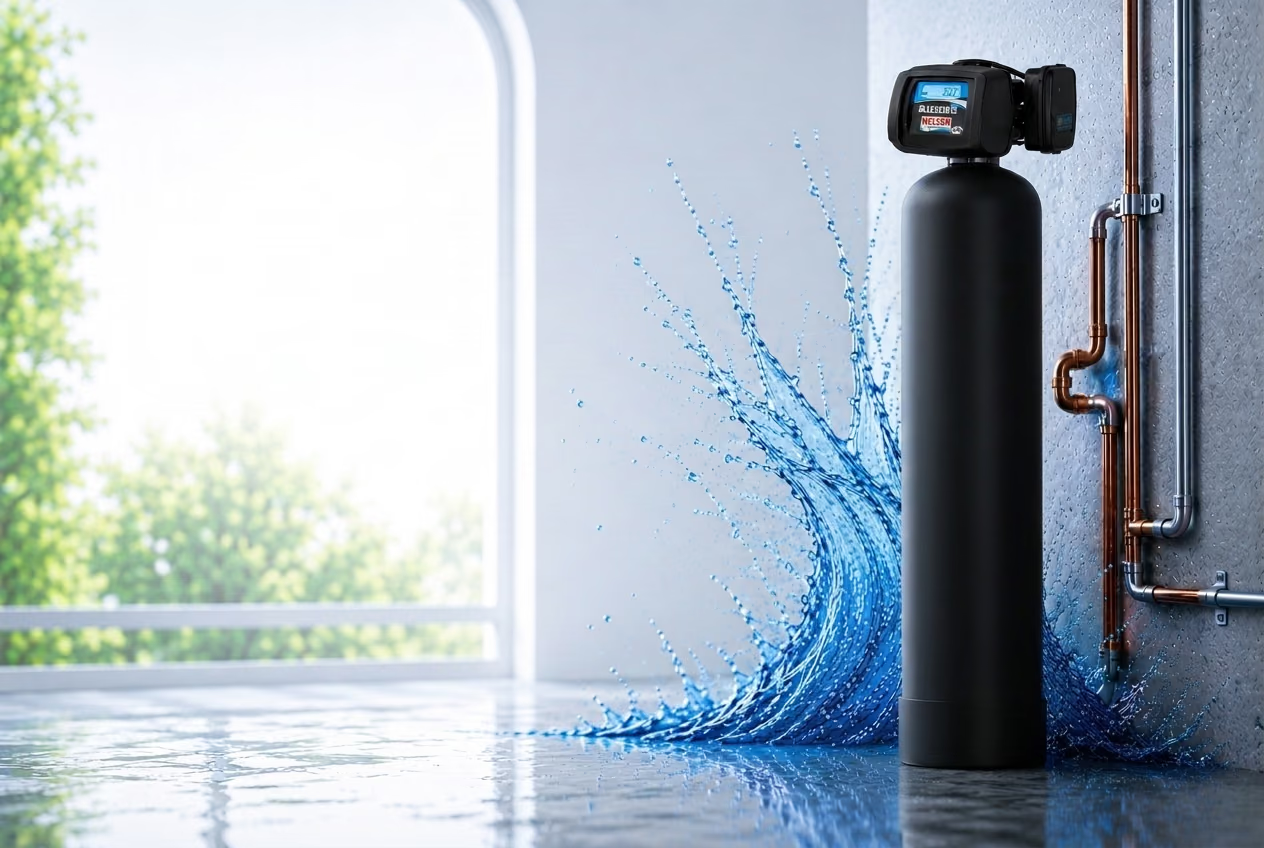
An iron filter for well water is what stops the orange staining before it reaches a fixture. The toilet gets an orange ring within days of being scrubbed. There are rust streaks under the tub spout and a brown shadow around the drain, and the laundry comes out yellow no matter which detergent you switch to. The odd part is that the water looks clear coming out of the faucet: it is only the glass left on the nightstand that goes cloudy and brown by morning. Orange or rust stains in the toilet and tub are dissolved iron oxidizing inside your house, and on private wells between DeWitt and the river towns it is the most common complaint we hear. An iron filter for well water is the fix, but which filter, and whether your softener could handle it alone, depends on three numbers: how much iron, how much manganese, and in what form.
One thing up front: iron and manganese are staining problems, not health problems. The EPA's secondary standards (0.3 mg/L for iron and 0.05 mg/L for manganese) mark where porcelain starts to discolor and water starts to taste metallic, not where it becomes unsafe. Nobody should buy a whole house iron filter out of fear. You buy one because you are tired of the bowl.
Why well water turns brown after it sits
Most iron in eastern Iowa wells is ferrous iron (dissolved, invisible, chemically reduced) because the fractured Silurian dolomite the wells sit in carries very little dissolved oxygen. The water leaves the well clear. The moment it meets air, the iron oxidizes to ferric iron, which is rust: an insoluble particle that tints the water, settles to the bottom of a glass and bonds to porcelain. A toilet bowl is the perfect demonstration (a few gallons sitting exposed to air for hours between flushes), which is why it stains first and worst. The same reaction is happening in the water heater, where oxidized iron settles as sludge, and in the toilet tank, where you will find a rusty film on the flapper.
If the water looks brown after it sits, the iron is oxidizing fast, and the numbers around here explain why. Grand Mound's two municipal wells, drilled about 250 feet into the same Silurian rock that private wells around DeWitt, Welton and Low Moor draw from, run 1.7 mg/L iron and 0.10 mg/L manganese in the raw water according to Iowa DNR sampling, nearly six times the iron staining threshold. Bedrock is only about 22 feet down at DeWitt, and USGS sampling of Silurian-Devonian municipal wells across Iowa found 41 percent over the 0.3 mg/L iron limit. Across the river in Fulton, the city's Well 4 raw water carries 1.3 to 1.5 mg/L iron and about 0.6 mg/L manganese before the city's iron-filter plant deals with it; the acreage wells in the same river sands outside the levee have no plant.
Red-water iron is the other case: water that comes out of the tap already tinted. That means the iron oxidized before it reached you (in the pressure tank, in old galvanized pipe, or in a well with an air leak), and it changes what we put ahead of the filter. It is one of the things we look for at the free test.
Iron, manganese and iron bacteria: three different problems
Iron leaves orange and rust-red. Manganese in well water leaves black or brown-black: dark flecks in the toilet tank, a charcoal ring at the waterline, a grimy film in the dishwasher. Its secondary standard is one-sixth of iron's, so a level that sounds trivial stains anyway. Lake Huntington Estates, an Eldridge-addressed acreage community on its own untreated wells, tests 0.23 to 0.27 mg/L manganese every year, roughly five times the limit. Manganese is also harder to oxidize than iron; it needs a higher pH or a stronger oxidizer and a catalytic media, which is why a filter that clears the orange can leave the black behind if it was sized for iron only. Clinton County's health department tests manganese free for private wells, and so do we.
Iron bacteria are the third problem. They are harmless organisms that feed on dissolved iron and leave a reddish-brown slime in the toilet tank, an oily sheen on standing water and sometimes a musty smell. They foul air-injection filters, so when we see slime in the tank we point you at an ozone system, which kills the bacteria and oxidizes the iron in one pass. If the water also smells like rotten eggs, that is a sulfur problem with its own page and its own explanation of why wells smell that way; ozone handles iron and sulfur together.
How an air-injection iron filter works
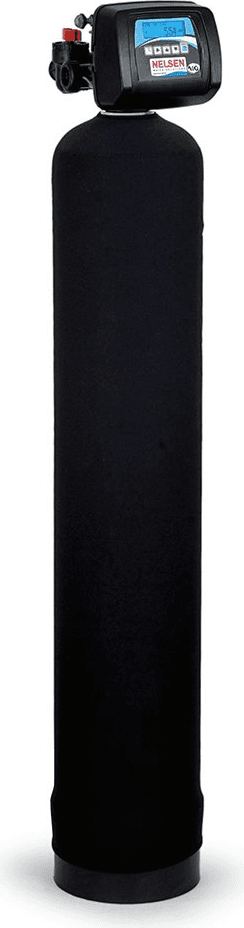
An air-injection iron filter is one tank, a control valve on top and no chemicals. The valve holds a pocket of air in the upper part of the tank. Water from the pressure tank sprays down through that air pocket, the dissolved ferrous iron oxidizes on contact, and the rust particles fall onto a catalytic media bed that traps them and finishes converting whatever is still dissolved. Clear, iron-free water leaves the bottom of the tank for the rest of the house.
Every few nights (the valve is programmed for it, usually around 2 a.m.) the tank backwashes. Flow reverses, the trapped rust is flushed to a drain, the media resettles and the valve draws a fresh charge of air. That backwash is the whole maintenance program: no salt, no cartridges, no chemical feed to refill. It also sets the one hard requirement. The well pump has to deliver enough flow to lift and rinse the media, typically 5 to 10 gallons per minute depending on tank diameter, and there has to be somewhere for that water to go: a floor drain, a laundry standpipe or a dedicated line. On the Illinois side, backwash discharge and septic systems are regulated separately, and we route the drain where the code allows.
Air injection covers most wells in our territory: dissolved iron into the several-mg/L range, moderate manganese when the pH cooperates and light sulfur odor. Past that, or with iron bacteria present, the air pocket cannot oxidize fast enough and an ozone feed ahead of the same style of backwashing tank takes over.
Softener or iron filter? The ppm answer
A water softener exchanges dissolved ferrous iron the same way it exchanges calcium and magnesium, so the honest industry answer is that a properly set-up softener with the right resin and a resin cleaner can carry clear-water iron up to roughly 1 to 2 mg/L on its own. Below that, with no manganese, no slime and water that stays clear in a glass, we may tell you a softener is all you need.
Above it, the softener becomes the victim. Iron that oxidizes inside the resin tank coats the beads and does not rinse out during regeneration. Capacity drops, the unit regenerates more often and burns more salt, and eventually hardness and iron both pass through to the house: the "softener is running but the toilet is orange again" call that ends up on our repair page. Any red-water iron, any manganese and any iron bacteria push the answer to a dedicated filter regardless of the ppm. Sizing math tells the same story: each mg/L of iron adds several grains to the softener's compensated hardness, which is how a Grand Mound well at about 18 grains with 1.7 mg/L iron ends up needing a softener sized past 25.
Worth knowing
The sequence, when both are needed, is always the same: iron filter first, softener second. Softener resin should only ever see water the filter has already cleaned.
Sizing and placement
A whole house iron filter is sized on the water's numbers, not the number of bathrooms. Iron and manganese in mg/L set the media and the oxidizer; pH decides whether air alone will finish the manganese; service flow sets the tank diameter so the media bed is not blown through at peak demand; backwash flow, checked against what your pump and pressure tank can actually deliver, confirms the tank can clean itself. A 10-inch tank suits most two- and three-bath homes on a solid well; larger homes, shop buildings and wells with higher iron move up to 12 or 13 inches. Low-yield wells sometimes need a larger pressure tank or a staggered backwash schedule so the filter never starves.
Placement is after the pressure tank, before the softener, near a drain, with a bypass valve so the house has water while the tank is serviced. If the well throws sand or grit, a sediment prefilter goes ahead of everything.
Expect the stains to stop building the day the filter goes in, not to vanish. The porcelain still needs a rust remover, the water heater needs a flush and old galvanized runs can bleed rust for a couple of weeks. After that, a clean bowl stays clean. If it ever does not, that is the signal the air charge or the media needs attention, which is a service call, not a replacement.
Where we install
We are based just east of DeWitt and serve private wells across Clinton, Jackson and Scott counties and the Illinois side of the river in Whiteside and Rock Island counties: the Silurian well belt around DeWitt, Grand Mound and Welton, the acreage communities and small water systems around Eldridge, the deeper Galena and Jordan wells in the townships around Maquoketa, and the river-bottom properties outside the Fulton levee. Inside Clinton, Iowa American Water's supply runs low in iron and carries a sequestrant to keep it that way, so in-town customers rarely need this page; the rural wells around Clinton are a different story. Commercial wells (restaurants, shops and ag buildings on their own well) get the same sizing, and the same free test on request.
The estimate is free, and if you want your iron measured, so is the in-home water test. Both are scheduled Monday through Friday, 8am to 5pm. If the bowl is orange and the whites are yellow, get a free estimate or call (563) 221-9009 and tell us what you are dealing with.