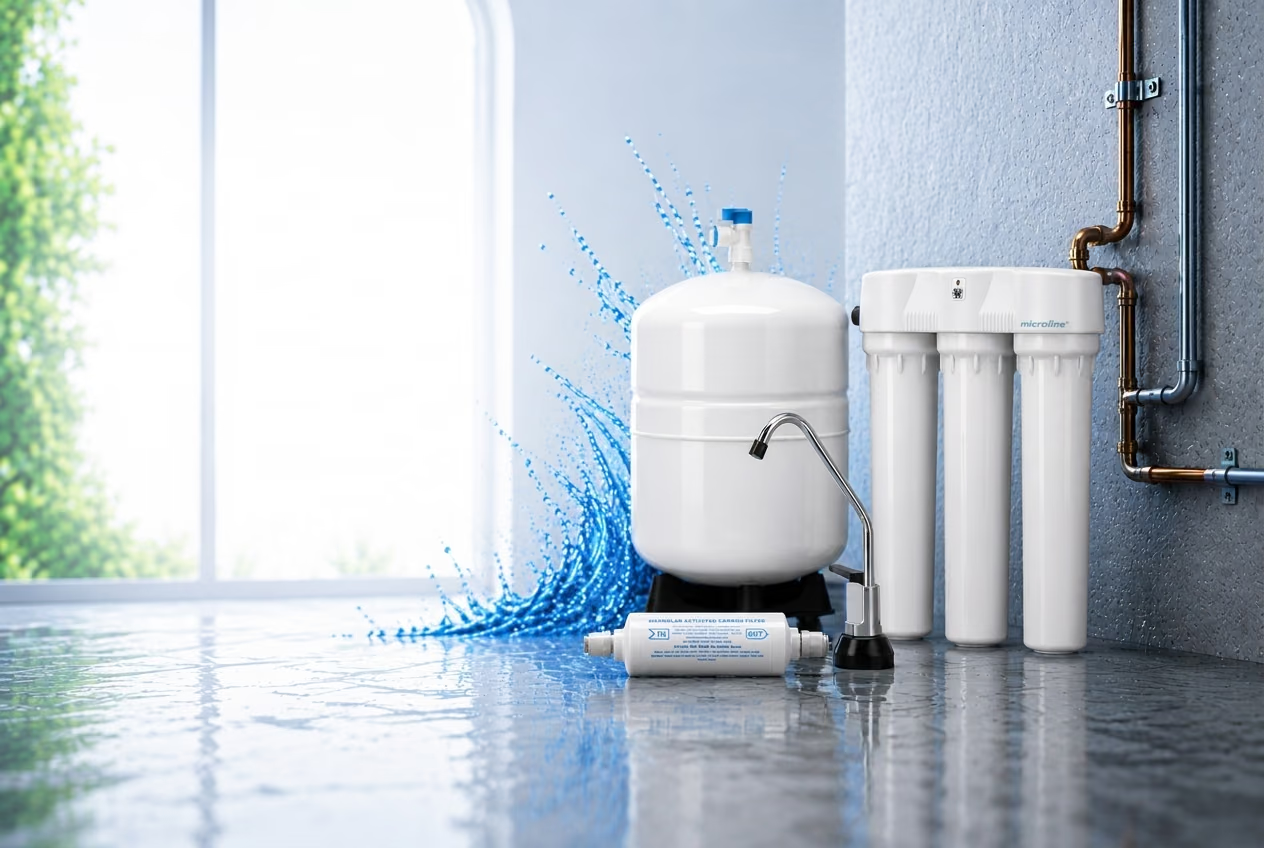
Your RO faucet is barely trickling. Filling the coffee pot takes a full minute, the ice maker tied into the drinking-water line makes a tray a day, and the water that used to taste clean now tastes flat, or faintly like the tap water you bought the system to get away from. Then you open the cabinet under the sink and try to remember when anyone last changed the filters. For a lot of the systems we open in DeWitt and the Quad Cities, the honest answer is three years. Reverse osmosis filter replacement is the most forgotten maintenance job in the house, because the system lives behind the trash can and works quietly right up until it doesn't.
Midwest Water Solutions services existing reverse osmosis and cartridge filter systems of any brand, under the sink or the whole-home unit in the basement: the one we installed, the one the previous owner left behind, the one that came in a box from a home center. Carson brings five years of hands-on water-conditioning experience to equipment from every manufacturer you'd recognize, and the job is the same regardless of the name on the housing. Test what the system is actually doing, replace what's spent, sanitize it, and leave you with a calendar you can keep.
How often to change reverse osmosis filters (the real calendar)
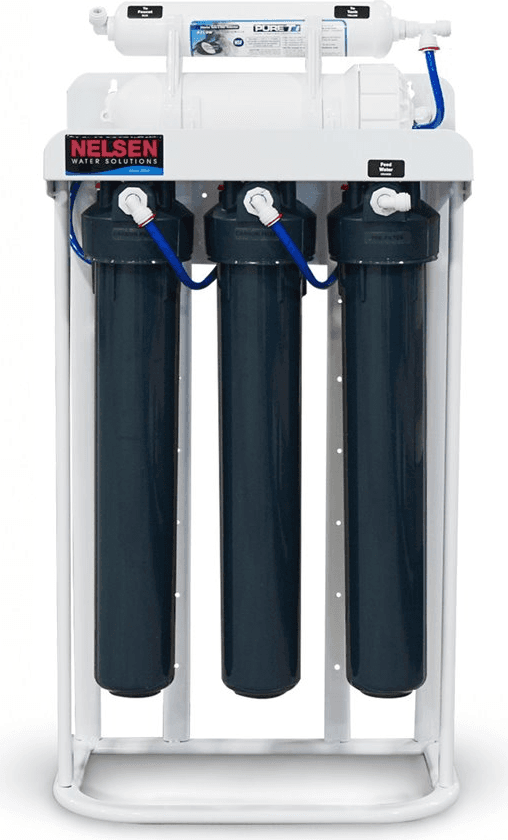
A typical under-sink RO has four or five stages in a row: a sediment pre-filter, one or two carbon pre-filters, the RO membrane, a post-carbon polishing filter, and sometimes a remineralization cartridge. Each one wears out on its own clock.
- Sediment and carbon pre-filters: every 6 to 12 months. On Davenport and Bettendorf city water, which is disinfected with chloramine, the carbon block is the filter that matters most. Chloramine chews through a thin-film membrane, and the carbon block is the only thing standing in front of it. Once the carbon is spent, the membrane dies quietly. On a private well with iron and sediment, the sediment pre-filter can load up in three or four months.
- Post-carbon polishing filter: every 12 months. This is the flat-taste filter. It sits after the storage tank and cleans up whatever the water picked up sitting in there.
- RO membrane: every 2 to 5 years, based on a test, not the calendar. A membrane behind properly changed pre-filters on softened water can run five years. One fed hard, chloraminated water through a clogged carbon block can be done in eighteen months.
- RO storage tank: check the air charge yearly; replace when the bladder fails. More on that below, because it's the part nobody looks at.
Those are typical industry intervals. Your real calendar depends on what's in your water, and the free in-home water test is there if you want to know.
Why your RO slowed down or tastes flat
Worth knowing
Slow flow has a handful of common causes, and the tank tells you which one you have before a single filter comes off.
The faucet trickles but the tank feels heavy and full. The RO storage tank is a steel or plastic shell with a rubber bladder inside and an air charge behind it (typically 5 to 7 psi when the tank is empty). That air pressure is what pushes water up to the faucet. When the charge leaks out over the years, the tank fills with water it can't deliver. Sometimes we can re-air it; when the bladder has waterlogged or split, the tank gets replaced.
The faucet trickles and the tank is light and empty. The system isn't making water fast enough to fill it. Nine times out of ten, the sediment or carbon pre-filters are clogged and starving the membrane. The rest of the time it's the membrane itself, scaled over because the softener was bypassed or never installed. DeWitt city water runs around 13 grains per gallon and rural Silurian wells closer to 18, and that hardness plates onto a membrane fast. Low incoming pressure is the sleeper cause on well homes: an RO wants roughly 40 psi or better, and a pressure tank cutting in at 30 spends half its cycle below that.
The water tastes flat, or tastes like tap water again. Usually the post-carbon filter is exhausted. If a TDS meter shows the RO water creeping up toward the tap number, the membrane is passing dissolved solids and it's time for a membrane swap, not just a cartridge.
The system hisses or runs to the drain constantly. A stuck automatic shut-off valve or check valve keeps sending water down the drain line even with the tank full. It wastes water, and it can keep the tank from ever filling completely.
Water in the cabinet. Quick-connect fittings, cracked housings and tired O-rings account for most of it, and a small drip becomes a warped cabinet floor in a week. A fitting that has let go and is flooding the cabinet is the one RO problem we treat as an emergency: shut the feed valve on the cold line, then call: our phone line is answered 24/7 and we're on-site within 2 hours.
Membrane testing: is it still removing what you bought it for?
This is the part of a service visit that matters most and gets skipped most. We put a TDS meter on the tap water feeding the system and on the RO water coming out. A healthy RO membrane rejects 90 to 98 percent of dissolved solids; if the tap reads 500 and the RO reads 25, you're at 95 percent and the membrane is fine. When rejection drops below about 80 percent, the membrane is finished no matter what the calendar says.
The safety reason for the test is that a tired membrane fails quietly. DeWitt's deep Jordan wells run about 500 to 550 TDS raw, with sodium around 110 to 120 ppm and combined radium that has measured 3.1 pCi/L at two of the city's wells. Shallow private wells in this part of eastern Iowa have tested over the 10 mg/L nitrate limit after wet springs. RO handles all of those (that's usually why the system was bought), but nitrate, sodium and radium have no taste. If the membrane has slipped to 60 percent rejection, the water still tastes fine and the system has stopped doing its job. We check it once a year, write the numbers on the log, and replace the membrane when the trend says to. If your test turns up something your current system was never rated for, that conversation belongs on our new reverse osmosis systems page.
Every filter change ends with a sanitize: unscented bleach or a food-grade sanitizer run through the empty housings and the RO storage tank, held, then flushed until the water is clear and odor-free. Skipping it is how a "clean" system grows slime on the inside of a tank.
Whole-house cartridge filters and sediment screens
The same visit covers the point-of-entry cartridge housings in your basement or utility room: the 10-inch and 20-inch "big blue" sediment housings, the spin-down filter with the clear bowl and flush valve, and carbon block cartridges. When customers say the filter screens keep clogging, the fix is almost always upstream of the screen. Sand means a well pump pulling from a worn screen. Rust-colored sludge on a sediment cartridge after a few weeks means dissolved iron (1 to 2 mg/L is normal in the Silurian wells around DeWitt, Grand Mound and Welton) turning to particles the moment it hits air. A 5-micron cartridge choking on that is doing exactly what it's supposed to do, and no water filter replacement schedule can keep up with it. The honest answer is a coarser first stage to catch the heavy load, a flush valve on a spin-down so you can clear it without opening the housing, or, when iron is the real problem, an iron filter ahead of everything else.
Carbon cartridge housings on city water are a different story: they run 6 to 12 months and their failure mode is the pool smell coming back. Whole-house chlorine and chloramine treatment is covered on our carbon filters page.
Any brand, any age
We service every brand of RO and filter system: Culligan, Kinetico, EcoWater, Whirlpool, GE, and the online and home-center kits, so you get the cartridge your system takes rather than a pitch for a different system. Most units use industry-standard 2.5-by-10-inch cartridges and a standard membrane; some brands use proprietary twist-off cartridges, and we source those too. If a manufacturer no longer makes the parts, we'll tell you before you pay for a visit. Softener trouble on the same visit (a unit that won't stop running, a leak at the valve) is handled under water softener repair and service.
Service plans and reminders
The reason filters go three years is that nobody wrote down when they went in. At the end of every visit we log the brand, model, cartridge sizes, membrane date, tank pressure and the TDS readings, and we set the reminder for the next change so the call comes from us. An annual RO service (pre-filters, post-filter, TDS test, tank check, sanitize, leak inspection) is the same visit most homeowners pair with their softener check. Restaurants, offices and shop buildings running RO for ice, coffee or process water get the same log on a shorter interval, because a commercial membrane sees a lot more gallons.
If the RO faucet under your sink has slowed to a trickle, the water has gone flat, or you honestly can't remember the last change, call (563) 221-9009 or request a free estimate. We schedule service Monday through Friday, 8am to 5pm, across DeWitt, Clinton, Davenport, Bettendorf, Eldridge and the rest of the Quad Cities. Tell us the brand or send a photo of the cartridges, and we'll bring the right ones.