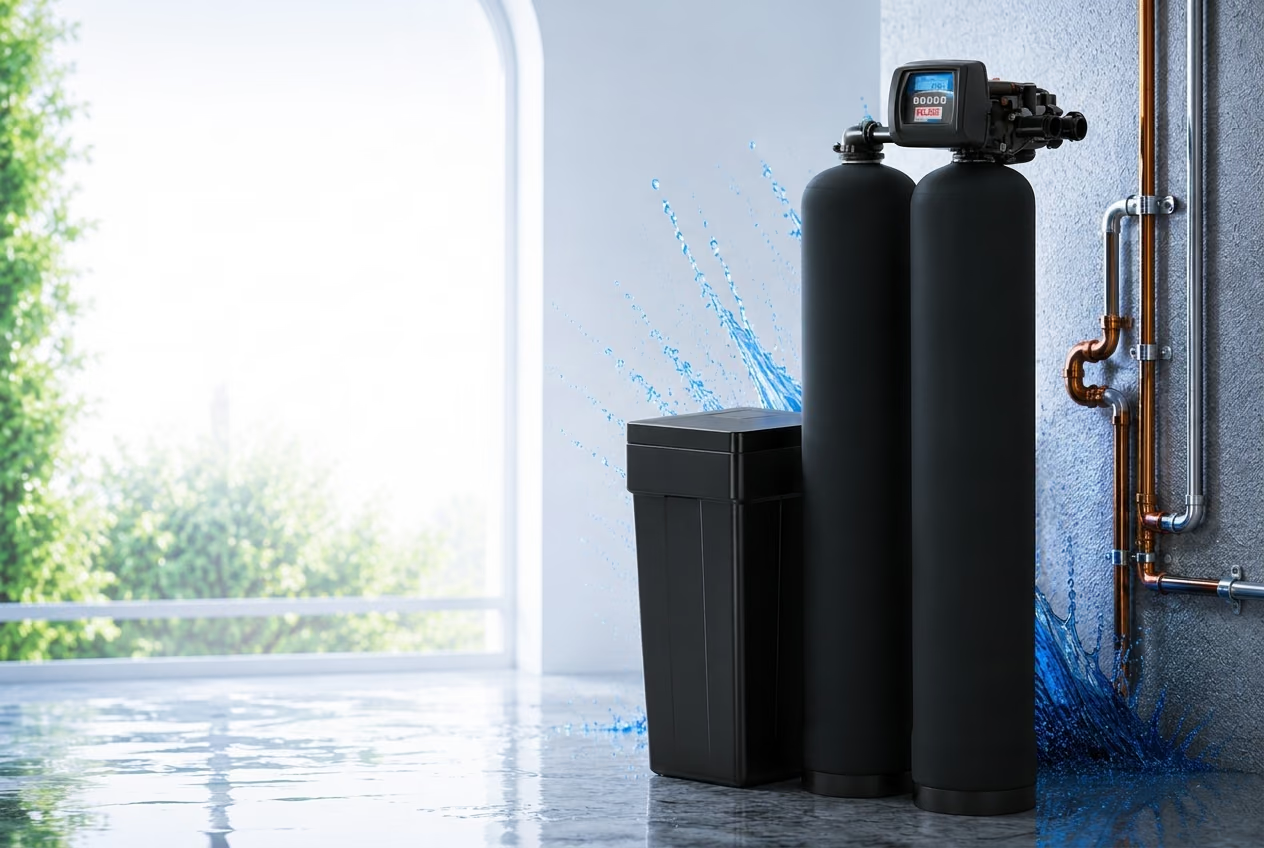
Water softener installation is what ends the cycle of early appliance failures and white film on everything. Your water heater died early, six years in, well short of what a tank should last. The dishwasher has white film on every glass no matter which detergent you switch to. The showerhead is clogged again, three months after you soaked it in vinegar. None of those are appliance problems. They are one problem showing up in three rooms: hard water, roughly 8 to 20 grains per gallon on the Quad Cities river supply and 13 to 15 grains on the deep wells under DeWitt and Clinton, leaving calcium on every hot surface it touches. A new water softener installation in Davenport, the Quad Cities or DeWitt stops that at the point of entry, but only if the unit is sized from your actual hardness and plumbed correctly. That second part is where a softener is won or lost, and it is what Midwest Water Solutions is for.
Sizing a softener for an eastern-Iowa home
Hardly anyone around here gets softened water from the utility. Iowa American Water's Davenport and Bettendorf supply is Mississippi River water, published at 136 to 350 mg/L of hardness (7.9 to 20.4 gpg) with the number swinging by season. Clinton's Jordan wells printed 15.2 gpg in the 2017 report. DeWitt's city wells sample around 13 to 14 gpg raw. Rural Silurian wells on the uplands run harder still, often with a milligram or two of iron. A box-store softener sized for "average" water is sized for none of those.
So sizing starts with your own number. If you do not have one, the free in-home water test gets it: hardness in grains per gallon, iron, TDS, pH and chlorine, at your tap. From there the math is simple. Hardness times people times about 75 gallons per person per day gives the grains the unit must remove daily. Iron on a well adds 3 to 5 grains per part per million, because the resin bed strips iron too and pays for it in capacity. A four-person home on 15-grain water is about 4,500 grains a day, which lands on a 32,000-grain unit set to regenerate roughly weekly at a salt-efficient setting, not a 24,000-grain unit regenerating every three days and eating salt.
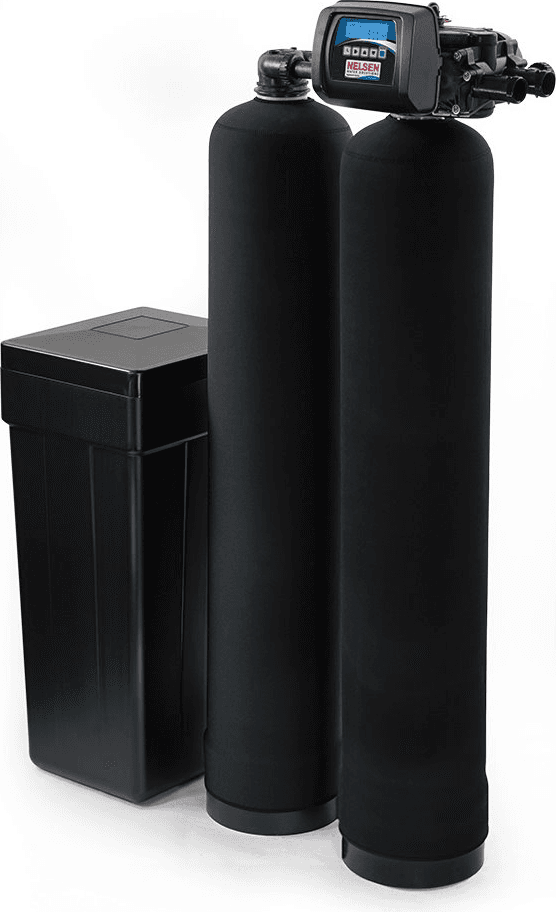
Valve type matters as much as tank size. We install metered, demand-initiated valves that count gallons and regenerate when the resin is actually spent. Timer valves regenerate on a clock whether you were home or on vacation, which wastes salt, water and sewer charges. In Eldridge, where water rates rose in July 2026, that difference shows up on the bill. If your water carries more iron than a softener should handle, we spec an iron filter ahead of it rather than asking the softener to do a job it was not built for. The hub page on water softeners covers the ion-exchange chemistry in more detail; this page is about buying and installing the right one.
What a professional installation includes
A softener install is plumbing work first and a piece of equipment second. Here is what goes into ours.
- The loop. The softener sits on a dedicated loop off the main after the meter, so the whole house is treated. Newer subdivisions usually have a loop stubbed and capped in the utility room. In a 1950s to 1970s ranch we cut one in, and on copper or galvanized we install a bonding jumper across the cut so the plumbing keeps its electrical ground.
- A bypass valve. Every unit gets an accessible bypass valve so you can isolate the softener for service or an emergency without shutting off water to the house. We show you where it is and how to turn it before we leave, so you can find it when the basement floor is wet.
- The drain line. Regeneration sends brine and rinse water down a drain, and it has to go to a floor drain, standpipe or laundry tub through an air gap (that gap is the cross-connection protection that keeps drain water from ever siphoning back into the resin tank). On rural septic, drain routing gets extra thought: Illinois private-sewage rules generally want softener backwash kept out of the septic tank, and Iowa's time-of-transfer inspection at every rural sale looks at exactly this.
- Brine tank placement. The brine tank goes where a 40-pound bag of salt can actually reach it and where a slow leak would hit the floor drain, not the finished side of the basement. We set it level, connect and secure the brine line, and fill it.
- Outside spigots left hard. Hose bibs for the lawn, garden and hot tub fill stay on untreated water unless you ask otherwise. Softened water on the lawn is wasted salt and capacity.
- Programming and a test regeneration. We enter your measured hardness, household size and any iron allowance into the valve, run a manual regeneration, watch the drain and brine draw, and check hardness downstream before we leave.
In most eastern-Iowa homes the softener lives in the basement utility corner next to the water heater, where the floor drain already is. Crawlspace and slab homes get a heated utility closet or garage location with a drain we can actually reach; a brine tank in an unheated garage is a frozen brine line in January. If your city requires a permit for the work, we sort that out with you before the install. Most residential installs are finished in a single visit, scheduled Monday through Friday, 8am to 5pm.
Replacing a rental or builder-grade unit
Two kinds of softeners get replaced most often here. The first is the rental. Rental units are marketed heavily across the Quad Cities, and the arithmetic on a rental turns against you after a few years: you keep paying and never own anything, and the unit is often the smallest one that made the monthly number work. When you replace a rental softener with one you own, we disconnect and cap the loop so the rental can go back, then install the new unit on the same loop if the plumbing is sound. If the old bypass valve is corroded or the drain was run without an air gap, we fix that while we are there.
The second is the builder-grade unit in a 2000s to 2010s subdivision: the Hopewell and Forest Grove side of Bettendorf, the newer sections of Eldridge, Jacobson Farms in DeWitt, the 53rd Street ring in Davenport. The builder installed the softener that fit the allowance, not the water. Fifteen to twenty-five years later the resin bed is worn and the timer valve has been regenerating on a schedule the whole time. Those homes almost always have a clean pre-plumbed loop, which makes the swap straightforward: pull the old tanks, set the correctly sized unit, reprogram, done in a morning.
Worth knowing
Either way, if the old unit is leaking or stuck in regeneration right now and flooding the basement, that is not an install call. It is a repair call. We keep a 24/7 phone line and are on-site within 2 hours for emergencies like a softener that will not stop running; details are on the water softener repair page.
What a water softener costs installed (national ranges)
Water softener installation cost is the question everyone asks first, so here is the honest version. National cost guides put a typical installed single-tank, metered whole-house softener at roughly $1,500 to $4,000. Basic timer units come in closer to $1,000; dual-tank systems and softener-plus-iron-filter packages for well homes run above $5,000. Those are national ranges, not our prices, and they are what the "average cost of a water softener system" searches are really asking about.
What moves your number is specific: hardness (a 15-grain house needs more resin than an 8-grain house), whether a loop exists or we are cutting into copper in a 1960s Davenport basement, how far the drain has to run, and whether an iron filter or sediment prefilter belongs in front of the softener. The local number comes from a written free estimate built on your house and your water, and there is no pressure to buy the biggest tank on the truck.
Where we install
From our shop just east of DeWitt we install softeners across Clinton, Jackson and Scott counties and the Illinois side of the Quad Cities. In Davenport, where the median house dates to 1967 and a quarter of the stock is pre-1940, installs mean galvanized and copper, stone basements and no existing loop. Bettendorf and Eldridge are the opposite: PEX, capped loops and tankless heaters scaling fast on unsoftened water. DeWitt splits between both. Clinton sits on some of the hardest municipal water on the Iowa side at roughly 15 grains, and Rock Island has no published hardness figure at all, which is one more reason the free tap test is worth having there.
After the install, our salt delivery keeps the brine tank stocked, and we service every brand we sell. If you want to see how other homeowners have found the work, our 5-star Google reviews are public. When the water heater, the dishwasher and the showerhead all start telling you the same thing, call (563) 221-9009 or request a free estimate. The estimate is free, the water test is free if you want one, and the softener will be sized for your water.